Best Indian Forts to Visit in 2026 — The Ultimate Heritage Travel Guide
India is a country of forts. From the icy Himalayan foothills to the palm-fringed southern coastline, from the golden Thar Desert to the lush Deccan Plateau — India's landscape is dotted with over 25,000 forts, fortresses, and citadels built over 3,000 years of extraordinary history. No other country on earth offers such a density and diversity of historical military architecture — each fort a layered story of conquest, courage, artistry, and royal ambition.
For international travellers from the USA, UK, Canada, Germany, and France visiting India in 2026, the country's forts are among the most awe-inspiring and most photographed destinations in all of Asia — and for very good reason. Standing before Mehrangarh Fort rising 400 feet above Jodhpur's blue rooftops, or walking the mirrored corridors of Amber Fort as the morning sun ignites a thousand reflections around you — these are experiences that permanently alter your sense of what human beings are capable of building.
This guide covers the best Indian forts to visit — categorised by region, with entry fees, visiting tips, best time to visit, and how to include each in your India tour itinerary. We begin, naturally, with Rajasthan — India's Fort Capital.
Why India's Forts Are Unlike Anything Else in the World
Before we explore the forts themselves, it is worth understanding what makes India's forts so extraordinary — and why they attract millions of visitors from across the USA, UK, Europe, and beyond every year.
India's forts are not ruins. They are not empty shells of stone behind a velvet rope. They are living, breathing monuments — many still inhabited, many still functioning as palaces, temples, bazaars, and communities. Jaisalmer Fort is the only living fort in the world, its golden sandstone marvel from the 12th century housing havelis, temples, and residents amid Thar Desert vistas.
India's forts tell stories that span every period of Indian history — from the ancient Rajput kingdoms of the 7th century, through the Mughal imperial era of the 16th and 17th centuries, the Maratha empire, the Deccan Sultanates, and the British colonial period. Every fort is a chapter in a civilisation's story — and every carved stone, every mirrored ceiling, every cannon-scarred gateway is a sentence in that chapter.
The two most famous forts — the Agra Fort and the Red Fort — are among the UNESCO World Heritage Sites in India. Just like them, there are a number of hill forts, marine forts, and jungle forts that are perfect for a day out.
Best Forts in Rajasthan — India's Fort Capital
Rajasthan is, without question, India's greatest fort destination — and one of the world's finest. No other region on earth concentrates so many magnificent, well-preserved, and historically rich fortresses within driving distance of each other. A Rajasthan fort tour is the centrepiece of every India heritage tour — and rightly so.
1. Amber Fort (Amer Fort) — Jaipur #1 Must Visit
Location: Amber, 11 km from Jaipur city centre
Built: 1592 (by Raja Man Singh I, expanded by successive rulers)
Dynasty: Kachhwaha Rajputs
UNESCO Status: UNESCO World Heritage Site (Hill Forts of Rajasthan, 2013)
Entry Fee: ₹100 (Indians) | ₹500 (Foreigners) | ₹100 extra for camera
Best Time to Visit: 8:00 AM – 11:00 AM (before crowds, best light)
Visiting Time Required: 2.5 to 3 hours minimum
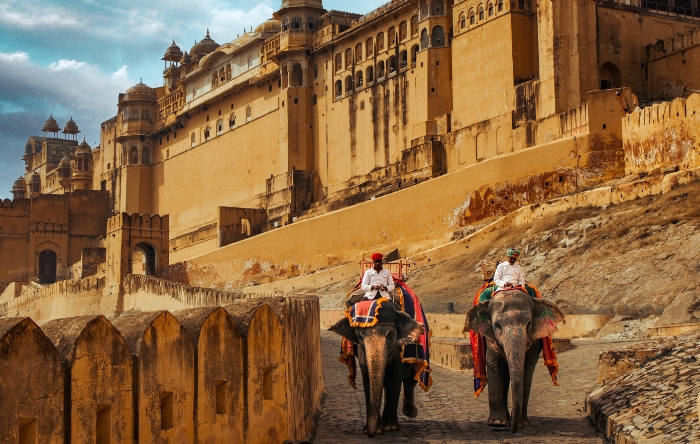
Amber Fort is the crown jewel of Rajasthan's forts — and the most visited heritage monument in the state, consistently ranked among India's top five historical sites by international travellers. Built from pale yellow and pink sandstone and white marble, Amber Fort sits dramatically on a ridge above Maota Lake, its reflection shimmering in the water below.
What makes Amber Fort extraordinary for international visitors is not just its scale — though the scale is breathtaking — but its interiors. The Sheesh Mahal (Hall of Mirrors) is one of the most extraordinary rooms in India: a chamber whose every surface — walls, ceiling, arched alcoves — is covered in thousands of tiny convex mirror fragments arranged in intricate floral and geometric patterns. When a single candle was lit in the Sheesh Mahal, the entire room blazed with the reflected light of a thousand stars. Today, a small torch demonstration gives visitors a glimpse of this extraordinary effect.
Key Highlights at Amber Fort:
- Sheesh Mahal — the legendary Hall of Mirrors, the finest in India
- Ganesh Pol — the most ornately decorated gateway in Rajasthan, painted with extraordinary frescoes
- Diwan-i-Aam — the public audience hall where the Maharaja received his subjects
- Sukh Niwas — the pleasure palace with an ingenious ancient air-conditioning system using water channels
- Jai Mandir — the private royal apartments with carved marble screens
- Secret underground tunnel — connects Amber Fort to Jaigarh Fort above, used for royal escapes
- Maota Lake view from the ramparts — one of the finest fort panoramas in India
My Dream India Tour Tip: Book your Amber Fort visit for the 8:00 AM opening slot — the morning light on the pale sandstone is extraordinary for photography, the crowds are thin, and the cool morning air makes the uphill walk comfortable. Our licensed Jaipur guides bring the fort's stories alive in a way that transforms a sightseeing visit into a genuinely moving historical experience.
2. Mehrangarh Fort — Jodhpur India's Most Impressive Fort
Location: Jodhpur city centre (perched on a 400-foot rock)
Built: 1459 (by Rao Jodha, founder of Jodhpur)
Dynasty: Rathore Rajputs of Marwar
UNESCO Status: (not UNESCO listed, but widely considered India's finest fort)
Entry Fee: ₹100 (Indians) | ₹600 (Foreigners) | Audio guide included
Best Time to Visit: 9:00 AM – 12:00 PM
Visiting Time Required: 3 to 4 hours
Towering 400 feet above the blue-washed city of Jodhpur, Mehrangarh Fort is one of India's grandest and most formidable forts. Built in 1459 by Rao Jodha, its walls rise out of sheer rock, exuding strength and majesty. Inside, palaces like Moti Mahal, Phool Mahal, and Sheesh Mahal showcase the finesse of Rajput craftsmanship — stained glass windows, painted ceilings, and golden balconies. From the ramparts, the view of Jodhpur's indigo rooftops stretching to the horizon is breathtaking.
Mehrangarh is consistently voted India's finest fort by international travellers — and by architectural historians. Its sheer walls, rising directly from a rocky outcrop as if they grew from the earth itself, create a silhouette that is one of the most dramatic in all of Indian heritage photography. The fort appeared in several Hollywood and international productions — including Batman Begins, where it doubled as the League of Shadows' mountain fortress.
Key Highlights at Mehrangarh Fort:
- Moti Mahal (Pearl Palace) — the finest royal audience chamber in Marwar, with five concealed gallery windows through which the royal women could observe proceedings
- Phool Mahal (Flower Palace) — the most ornate room in the fort, covered in gold leaf and fine paintings
- Sheesh Mahal (Mirror Palace) — decorated with Belgian glass and intricate mirror work
- Chamunda Mata Temple — a sacred temple to the city's patron goddess, inside the fort walls
- Fort Museum — one of India's finest, containing royal weapons, palanquins, howdahs, costumes, and miniature paintings
- Cannon ramparts — with extraordinary panoramic views over the entire Blue City
- Seven gateways (Pols) — each with a different historical significance; some still bear cannonball marks from 18th-century battles
My Dream India Tour Tip: Mehrangarh's audio guide (included in the entry fee) is genuinely excellent — one of the best in India. Pair it with our licensed local guide for additional context and the stories behind the stories.
3. Jaisalmer Fort — Jaisalmer The Living Fort
Location: Heart of Jaisalmer city
Built: 1156 CE (by Rawal Jaisal)
Dynasty: Bhati Rajputs
UNESCO Status: UNESCO World Heritage Site (Hill Forts of Rajasthan, 2013)
Entry Fee: ₹50 (Indians) | ₹250 (Foreigners)
Best Time to Visit: Sunrise or sunset — the golden sandstone glows magnificently
Visiting Time Required: 3 to 4 hours (more to explore the living areas)
The only living fort in the world, this golden sandstone marvel from the 12th century houses havelis, temples, and residents amid Thar Desert vistas. Dubbed Sonar Quila (Golden Fort), it is a top tourist fort in India with rooftop cafes and cannon viewpoints.
Jaisalmer Fort is unique among all the great forts of India — it is not a monument you visit, it is a community you enter. Approximately 3,000 people still live within the fort's sandstone walls — in ornately carved havelis, around ancient Jain temples, in narrow lanes that have been inhabited for nine unbroken centuries. The fort rises from the flat Thar Desert like a sandcastle built by giants, its honey-gold sandstone changing colour from pale ivory at dawn to blazing amber at sunset to deep ochre at night when the fort is illuminated.
Key Highlights at Jaisalmer Fort:
- Raj Mahal (Royal Palace) — the multi-storey palace of the Bhati kings with extraordinary stone lattice screens
- Jain Temples — a cluster of seven Jain temples within the fort, dating from the 12th to 15th centuries, with extraordinary carved marble and sandstone interiors
- Havelis — elaborately carved merchant mansions within the fort, including Patwon ki Haveli outside
- Fort ramparts and cannons — with sweeping desert views and the blue shimmer of Sam Sand Dunes in the distance
- Rooftop cafes — some of India's most atmospheric dining, with desert panoramas and sunset views
4. Chittorgarh Fort — Chittorgarh India's Largest Fort
Location: Chittorgarh, southern Rajasthan (175 km from Udaipur)
Built: 7th century CE (by the Maurya dynasty)
Dynasty: Various — Maurya, Guhilot, Sisodia Rajputs
UNESCO Status: UNESCO World Heritage Site (Hill Forts of Rajasthan, 2013)
Entry Fee: ₹40 (Indians) | ₹600 (Foreigners)
Best Time to Visit: October to March, early morning
Visiting Time Required: 4 to 5 hours (it is enormous)
India's largest fort at 700 acres, this UNESCO World Heritage Site symbolises Rajput bravery with Vijay Stambh tower, Rani Padmini's Palace, and ancient temples. Once self-sufficient with water bodies, it is among the best forts in India for history buffs.
Chittorgarh is not just India's largest fort — it is India's most emotionally powerful fort. This is the place where Rajput history was forged in fire and sacrifice. Three times in its history, when the fort fell to overwhelming odds, the Rajput women performed Jauhar — mass self-immolation — rather than face capture. The stories of Rani Padmini, of Meera Bai, of Maharana Pratap — these are woven into the very stones of Chittorgarh, making it a fort where history is not just told but felt.
Key Highlights at Chittorgarh Fort:
- Vijay Stambh (Tower of Victory) — a 37-metre tower built by Maharana Kumbha in 1448 to commemorate his victory over Mahmud Khilji; climbable for extraordinary views
- Kirti Stambh (Tower of Fame) — a 22-metre Jain tower, older than Vijay Stambh, covered in carved Jain figures
- Rani Padmini's Palace — where the legendary beauty Rani Padmini refused to submit to Alauddin Khilji, setting in motion one of Rajputana's greatest tragedies
- Meera Temple — dedicated to the poet-saint Meera Bai, one of the most beloved figures in North Indian devotional history
- Gaumukh Reservoir — an ancient water storage system that made the fort self-sufficient during sieges
5. Kumbhalgarh Fort — Rajsamand The Great Wall of India
Location: Rajsamand district, 82 km from Udaipur
Built: 15th century (by Maharana Kumbha)
Dynasty: Sisodia Rajputs (Mewar)
UNESCO Status: UNESCO World Heritage Site (Hill Forts of Rajasthan, 2013)
Entry Fee: ₹40 (Indians) | ₹600 (Foreigners)
Best Time to Visit: October to February; attend the Kumbhalgarh Festival (December)
Visiting Time Required: 3 to 4 hours + optional trek
Famous for the world's second-longest wall at 36 km, the birthplace of Maharana Pratap, this hill fort offers panoramic views from Badal Mahal palace. A UNESCO Hill Fort of Rajasthan, ideal for treks and discovering architectural wonders.
Kumbhalgarh is the fort that most international visitors have never heard of — and the one they most often describe as the greatest surprise of their India trip. Its 36-kilometre perimeter wall — wide enough for eight horses to ride abreast — is the second-longest continuous wall on earth after the Great Wall of China. And yet, somehow, Kumbhalgarh remains blissfully less crowded than Amber or Mehrangarh, offering a more contemplative, more atmospheric fort experience.
Key Highlights at Kumbhalgarh Fort:
- The Great Wall — 36 km of continuous battlements, towers, and gateways
- Badal Mahal (Cloud Palace) — the highest point of the fort, with extraordinary views over the Aravalli Hills
- Birthplace of Maharana Pratap — the room where Rajputana's greatest warrior hero was born in 1540
- 300+ Jain and Hindu temples within the fort complex
- Kumbhalgarh Wildlife Sanctuary surrounding the fort — leopards, wolves, sloth bears
6. Nahargarh Fort — Jaipur Best Sunset Viewpoint
Location: Aravalli Hills above Jaipur, 19 km from city centre
Built: 1734 (by Maharaja Sawai Jai Singh II)
Dynasty: Kachhwaha Rajputs
Entry Fee: ₹50 (Indians) | ₹200 (Foreigners)
Best Time to Visit: Late afternoon to sunset — 4:00 PM to 6:30 PM
Visiting Time Required: 1.5 to 2 hours
Nahargarh ("Tiger Fort") was built as a retreat and pleasure palace for Maharaja Jai Singh II and his nine queens — each of whom had an identical suite of rooms connected to the central corridor, so the Maharaja could visit each privately. The nine-suite Madhavendra Bhawan is one of the most unusual and charming examples of Rajput palace architecture in Jaipur.
But the real reason most visitors come to Nahargarh is the sunset. Perched on the ridge above Jaipur, Nahargarh commands one of the finest urban panoramas in India — the entire Pink City stretching below, the Jal Mahal floating on its lake, Amber Fort visible in the distance, and Jaipur's illuminated skyline emerging as darkness falls.
Best Mughal Forts — Delhi & Agra
7. Red Fort (Lal Qila) — Delhi India's National Symbol
Location: Old Delhi, Chandni Chowk area
Built: 1639–1648 (by Mughal Emperor Shah Jahan)
Dynasty: Mughal Empire
UNESCO Status: UNESCO World Heritage Site (2007)
Entry Fee: ₹35 (Indians) | ₹500 (Foreigners)
Best Time to Visit: Morning; attend the evening Sound & Light Show
Visiting Time Required: 2 to 2.5 hours
No list of Indian forts is complete without the Red Fort. This UNESCO World Heritage Site is more than just a tourist spot — it is a national symbol. Made of vibrant red sandstone, this fort served as the royal home of the Mughals for almost two centuries. India's first Prime Minister addressed the nation from the Red Fort on Independence Day in 1947 — a tradition that still continues every year.
The Red Fort is the heart of India's national identity — the place where the Indian flag is raised every Independence Day (August 15th), where Prime Ministers address the nation, and where the world watches India celebrate its freedom. As a heritage monument, it is a magnificent example of Mughal imperial architecture — its crimson sandstone walls stretching 2.5 kilometres around a complex of extraordinary palaces, pavilions, and gardens.
Key Highlights at Red Fort:
- Lahori Gate — the main ceremonial entrance, through which Mughal emperors processed in state
- Diwan-i-Aam (Hall of Public Audience) — the vast courtyard where the Emperor received public petitions
- Diwan-i-Khas (Hall of Private Audience) — where the legendary Peacock Throne once stood, inscribed with the Persian verse: "If there is paradise on earth, it is here, it is here, it is here"
- Rang Mahal (Painted Palace) — the living quarters of the Emperor's wives, with a lotus-shaped marble fountain
- Nahr-i-Bihisht — a water channel running through the royal apartments, called "Stream of Paradise"
- Museums — multiple museums within the fort complex covering Mughal history, weapons, and archaeology
- Sound & Light Show — one of India's finest, narrating 5,000 years of Delhi's history through the fort's gates and walls
8. Agra Fort — Agra The Taj Mahal's Magnificent Neighbour
Location: Agra, 2.5 km from the Taj Mahal
Built: 1565 (begun by Emperor Akbar; expanded by Jahangir and Shah Jahan)
Dynasty: Mughal Empire
UNESCO Status: UNESCO World Heritage Site (1983)
Entry Fee: ₹50 (Indians) | ₹550 (Foreigners)
Best Time to Visit: Morning; combine with Taj Mahal same day
Visiting Time Required: 1.5 to 2 hours
A UNESCO red sandstone masterpiece by Akbar, this Mughal stronghold features Jahangiri Mahal, Diwan-i-Khas, and Taj Mahal views.
Agra Fort is the Taj Mahal's magnificent neighbour — and one of the most historically poignant places in India. It was here that Shah Jahan, the emperor who built the Taj Mahal for his beloved wife Mumtaz, was imprisoned by his own son Aurangzeb in his final years — able to see the gleaming white dome of his greatest creation from the windows of his marble tower, but never again permitted to visit it.
Key Highlights at Agra Fort:
- Jahangiri Mahal — the finest Hindu-style palace within a Mughal fort, built by Akbar for his Rajput wives
- Khas Mahal — Shah Jahan's private marble palace with extraordinary pietra dura inlay work
- Musamman Burj (Octagonal Tower) — where Shah Jahan was imprisoned, with a direct Taj Mahal view
- Diwan-i-Khas — the private audience hall with twin marble thrones
- Sheesh Mahal — a mirrored bathing suite that rivals Amber Fort's famous mirror work
Best Forts in South India
9. Golconda Fort — Hyderabad The Diamond Fort
Location: Hyderabad, Telangana (11 km from city centre)
Built: 13th century (expanded by Qutb Shahi dynasty in 16th century)
Dynasty: Kakatiya, Bahmani, Qutb Shahi
Entry Fee: ₹25 (Indians) | ₹300 (Foreigners)
Best Time to Visit: Morning; attend evening Sound & Light Show
Visiting Time Required: 2.5 to 3 hours
This South Indian glory is known for its rich history. With its 10 km long wall, the grandeur stands apart. It is believed that major gemstones of the country were mined from here.
Golconda was once the diamond capital of the world. The Koh-i-Noor, the Hope Diamond, and virtually every great diamond in history passed through Golconda's markets. The fort itself is an engineering masterpiece — its acoustic system is so perfectly designed that a hand clap at the main gate can be heard clearly at the highest point of the fort, 91 metres above.
Key Highlights at Golconda Fort:
- Fateh Darwaza (Victory Gate) — the famous acoustic gateway where the hand-clap demonstration is performed
- Bala Hissar Gate — the ceremonial entrance with intricate tilework
- Taramati Mosque — one of the finest Qutb Shahi mosques within the fort complex
- Durbar Hall — the royal audience chamber with panoramic Hyderabad views
- Ramdas Jail — where the Hindu cashier Ramdas was imprisoned for embezzling funds to build a temple
10. Bekal Fort — Kerala India's Most Scenic Coastal Fort
Location: Kasaragod district, northern Kerala
Built: 1650 CE (by Shivappa Nayaka of Keladi)
Entry Fee: ₹25 (Indians) | ₹100 (Foreigners)
Best Time to Visit: Sunrise or sunset — the Arabian Sea views are extraordinary
Visiting Time Required: 1 to 1.5 hours
Bekal Fort is Kerala's largest and best-preserved fort — a massive keyhole-shaped fortification jutting into the Arabian Sea on a natural rocky headland, surrounded by the sea on three sides. The fort is relatively unknown to international visitors but is one of the most visually spectacular coastal forts in India. The view from the fort's observation tower — the Arabian Sea on one side, a palm-fringed beach on the other — is genuinely extraordinary.
Best Hill Forts in India — Maharashtra & Central India
11. Gwalior Fort — Gwalior The Pearl of Fortresses
Location: Gwalior, Madhya Pradesh (320 km south of Delhi)
Built: 8th century CE (Man Singh Palace built 1486–1516)
Dynasty: Gurjara-Pratihara, Tomar, Mughal, Maratha
Entry Fee: ₹75 (Indians) | ₹250 (Foreigners)
Best Time to Visit: October to March; evening Sound & Light Show
Visiting Time Required: 3 to 4 hours
Described by Mughal Emperor Babur as "the pearl in the necklace of India's forts," Gwalior Fort is a masterpiece of defense and design. Rising steeply from a sandstone plateau, it commands sweeping views of the city below. The fort's façade, adorned with vibrant blue tiles and intricate carvings, is a sight to behold. Inside lie the palaces of Man Singh and Gujari Mahal, a blend of Rajput and Hindu artistry. The fort also houses ancient rock-cut Jain sculptures, adding to its spiritual dimension.
12. Raigad Fort — Maharashtra The Maratha Capital
Location: Raigad district, Maharashtra (70 km from Pune)
Built: 1030 CE (rebuilt and expanded by Chhatrapati Shivaji in 1674)
Dynasty: Maratha Empire
Entry Fee: ₹50 (Indians) | ₹200 (Foreigners)
Best Time to Visit: October to February (avoid monsoon)
Visiting Time Required: 3 to 4 hours including ropeway
Raigad Fort was the capital of Chhatrapati Shivaji's Maratha Empire — the mountain fortress from which one of India's greatest warrior kings administered a kingdom that challenged Mughal supremacy. Perched at 2,700 feet on a sheer-sided plateau in the Sahyadri Hills, Raigad is accessible by a modern ropeway — and the views from the summit are extraordinary. It was here that Shivaji was crowned Chhatrapati (Lord of the Universe) in 1674 — one of the most consequential coronations in Indian history.
UNESCO World Heritage Forts in India — Complete List
India's UNESCO World Heritage forts represent the finest and most significant military and royal architecture in the country:
|
Fort
|
Location
|
Year Listed
|
Dynasty
|
|
Red Fort
|
Delhi
|
2007
|
Mughal
|
|
Agra Fort
|
Agra, UP
|
1983
|
Mughal
|
|
Amber Fort
|
Jaipur, Rajasthan
|
2013
|
Rajput (Kachhwaha)
|
|
Chittorgarh Fort
|
Chittorgarh, Rajasthan
|
2013
|
Rajput (Sisodia)
|
|
Kumbhalgarh Fort
|
Rajsamand, Rajasthan
|
2013
|
Rajput (Sisodia)
|
|
Ranthambore Fort
|
Sawai Madhopur, Rajasthan
|
2013
|
Chauhan Rajput
|
|
Gagron Fort
|
Jhalawar, Rajasthan
|
2013
|
Khichi Chauhan
|
|
Jaisalmer Fort
|
Jaisalmer, Rajasthan
|
2013
|
Rajput (Bhati)
|
The Hill Forts of Rajasthan — listed as a group UNESCO World Heritage Site in 2013 — represent the six finest surviving examples of Rajput military architecture, and form the core of any serious India heritage fort tour.
Fort Visit Tips for International Travellers
Book Amber Fort in Advance Amber Fort now requires timed entry tickets during peak season (October to March). Book online at rajasthantourism.gov.in at least a day in advance to avoid queues and secure your preferred time slot.
Hire a Licensed Local Guide India's forts are rich with stories, symbolism, and historical context that simply cannot be read from information boards. A licensed local guide — provided on all My Dream India Tour packages — transforms a sightseeing visit into a genuinely immersive historical experience. Guides hired at fort gates may be unlicensed and unreliable — always book through a reputable tour operator.
Photography Tips
- Amber Fort: Best light 8:00–10:00 AM (soft morning light on pale sandstone)
- Mehrangarh: Best from below (Blue City as foreground) at golden hour
- Jaisalmer Fort: Best at sunrise and sunset (golden sandstone glows magnificently)
- Red Fort: Best from across the moat, early morning, before tour groups arrive
Wear Comfortable Footwear India's forts involve significant walking on uneven, cobbled, and steep stone surfaces. Comfortable closed-toe shoes with grip are essential — not sandals.
Carry Water and Sun Protection Fort visits involve significant outdoor time, often on open battlements with no shade. Always carry bottled water (provided on all My Dream India Tour itineraries) and use sunscreen and a hat.
Dress Code Some forts contain active temples — dress modestly (covered shoulders and knees) to show respect and avoid being asked to cover up at the entrance.
Best Season for Fort Visits October to March is ideal for all North Indian and Rajasthani fort visits — cool temperatures, clear skies, and excellent photography light. Avoid May and June when temperatures can reach 45°C at Rajasthan forts.
Suggested Fort Tour Itineraries — My Dream India Tour
5-Day Jaipur Fort Circuit (Rajasthan Focus)
Day 1: Arrive Jaipur. Nahargarh Fort sunset
Day 2: Amber Fort (full morning) + Jaigarh Fort + City Palace
Day 3: Day trip to Ranthambore Fort (UNESCO) + optional tiger safari
Day 4: Drive to Jodhpur via Ajmer-Pushkar
Day 5: Mehrangarh Fort (full morning) + Blue City walk
7-Day Golden Triangle + Forts
Day 1–2: Delhi — Red Fort, Qutub Minar, Humayun's Tomb
Day 3: Delhi to Agra — Agra Fort + Taj Mahal at sunset
Day 4: Agra to Jaipur — Fatehpur Sikri en route
Day 5–6: Jaipur — Amber Fort, Nahargarh, Jaigarh
Day 7: Return to Delhi
12-Day Complete Rajasthan Fort Tour
Full circuit covering Amber, Nahargarh, Jaigarh (Jaipur) → Chittorgarh → Kumbhalgarh → Udaipur City Palace → Jodhpur Mehrangarh → Jaisalmer Fort — the definitive Rajasthan heritage tour.
Plan Your India Fort Tour with My Dream India Tour
India's forts are waiting — and our Jaipur-based team is the ideal guide to help you experience them. Based in the heart of Rajasthan, My Dream India Tour specialises in private, fully customised India heritage tours — combining the finest forts, palaces, and historical sites with comfortable accommodation, expert licensed guides, and seamless logistics.
Whether you want to spend 5 days exploring Jaipur's royal fort circuit or 12 days tracing the complete Rajasthan fort trail from Amber to Jaisalmer — we will design your perfect itinerary, arrange all fort entry tickets in advance, and ensure every visit is guided by a licensed heritage specialist who brings India's stories to life.
Explore our Rajasthan Tour Packages and Golden Triangle Tours — the perfect frameworks for an extraordinary India fort journey.
Call / WhatsApp: +91-87695-95984 | +91-70625-1282
Email: mydreamindiatour@gmail.com
Website: www.mydreamindiatour.com
Based in: Jaipur, Rajasthan — the Fort Capital of India
My Dream India Tour — Crafting Journeys as Timeless as India Itself.
Planning your India fort tour? Contact us with your travel dates and we will design your perfect heritage itinerary within 24 hours.
Frequently Asked Questions — Indian Forts
Q: Which is the most beautiful fort in India?
Amber Fort in Jaipur is most frequently cited as India's most beautiful fort — for its Sheesh Mahal interiors, its lake setting, and its extraordinary Ganesh Pol gateway. Mehrangarh Fort in Jodhpur is considered by many architectural historians to be India's finest in terms of overall scale, interiors, and dramatic setting.
Q: Which is the largest fort in India?
Chittorgarh Fort is considered the largest fort in India, spread across nearly 700 acres. It contains within its walls multiple palaces, temples, reservoirs, and military structures spread across a flat-topped hill.
Q: How many UNESCO World Heritage forts are there in India?
India has 8 UNESCO World Heritage listed forts — 2 Mughal forts (Red Fort and Agra Fort) and 6 Rajput hill forts in Rajasthan (Amber, Chittorgarh, Kumbhalgarh, Ranthambore, Gagron, and Jaisalmer).
Q: Is it worth hiring a guide at Indian forts?
Absolutely — a licensed local guide is one of the best investments you can make at any Indian fort. The history, legends, and architectural details that guides reveal transform a fort visit from sightseeing into a genuinely moving experience. My Dream India Tour provides licensed guides at all major forts on our tour packages.
Q: What is the best fort to visit near Delhi?
Agra Fort (2.5 hours from Delhi on the Yamuna Expressway) is the finest fort accessible from Delhi — and combining it with the Taj Mahal in a single day trip makes it India's most rewarding day excursion. Red Fort is the best fort within Delhi itself.
Q: Can I visit multiple Rajasthan forts in one trip?
Yes — and this is exactly what My Dream India Tour specialises in. A 10 to 12-day Rajasthan tour can comfortably cover all six UNESCO Hill Forts of Rajasthan plus Mehrangarh, with comfortable private vehicle transfers and licensed guides at every site.


.jpg)














.jpg)
.jpg)
.jpg)



.webp)