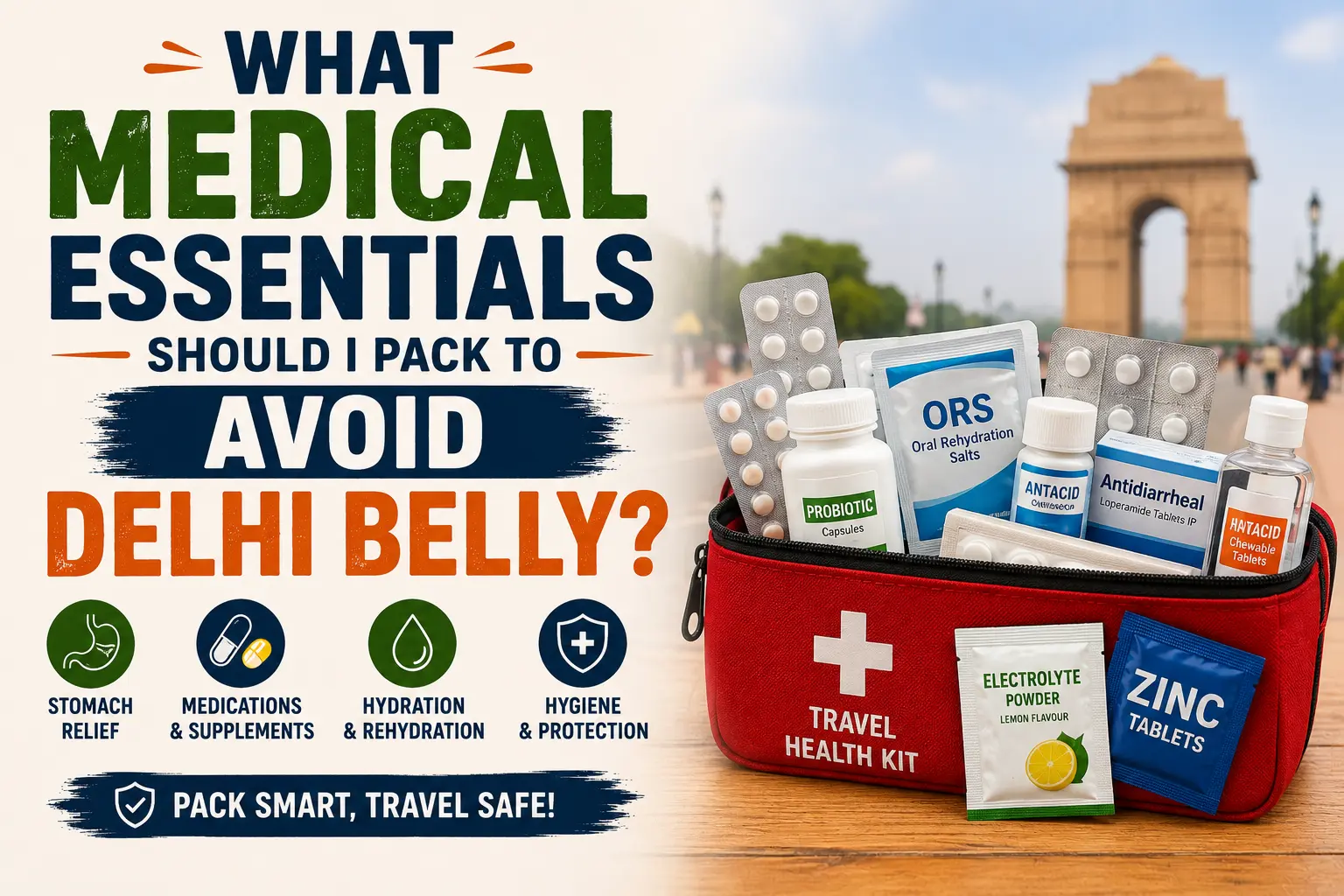
What Medical Essentials Should I Pack to Avoid Delhi Belly?
A Tour Guide's Completely Honest Health Kit for India
By Mukesh Sain | Founder, My Dream India Tour | Jaipur, Rajasthan Last Updated: 2026 | Reading Time: 12 minutes
Medical Disclaimer: This guide is written from personal experience guiding international tourists through India and is for general informational purposes only. It is not a substitute for professional medical advice. Always consult your doctor or a travel medicine specialist before travelling to India, particularly regarding vaccinations and prescription medications.
I am going to tell you something that most India travel blogs will not.
Delhi Belly is not inevitable. It is not a rite of passage. It is not something you simply have to accept as the price of visiting India.
In over a decade of guiding guests from the USA, UK, Canada, France, and Germany through Rajasthan, the Golden Triangle, and beyond, the guests who get sick on India trips are almost always the ones who arrived unprepared. And the guests who sail through two weeks of Indian street food, fort walks in Rajasthan's dust, and monsoon-season markets without a single stomach complaint are almost always the ones who packed the right medicine kit and followed a handful of simple food and water rules.
I know this because I see both outcomes, every week, across every tour I run.
This guide is the pre-trip health briefing I give every guest before they fly to India. It covers what Delhi Belly actually is, the complete medical kit you should pack, the prevention rules that genuinely make a difference, and exactly what to do if you get sick anyway.
Read it. Pack accordingly. Then come to India and eat everything.
What Is Delhi Belly — And Why Do International Tourists Get It?
Before we get into the medicine kit, let us understand what we are actually dealing with — because understanding the cause makes every prevention strategy make sense.
Delhi Belly is the colloquial name for traveller's diarrhoea experienced by visitors to India. It is a type of gastrointestinal illness typically caused by consuming food or water contaminated with bacteria, viruses, or parasites — most commonly Escherichia coli (E. coli), Salmonella, and occasionally Giardia or Cryptosporidium.
Here is the critical thing most people misunderstand: it is not the spice that causes Delhi Belly. It is not the richness of Indian food. It is the microbes. Bacteria like E. coli that Indian residents' digestive systems handle comfortably — because they have built immunity over a lifetime of exposure — hit a foreign gut with no established immunity like a wave hitting a beach with no seawall.
About 40% to 70% of travellers to India experience gastrointestinal upsets in their first week. That is a real statistic — and it is why preparation matters. But notice what it also means: 30% to 60% of visitors to India have absolutely no stomach issues at all. Those are the prepared, careful ones. Join that group.
The most common sources of Delhi Belly:
- Tap water — including ice cubes made from tap water
- Raw or undercooked vegetables washed in tap water
- Street food with poor temperature control
- Buffet food that has been sitting out
- Dairy products that are not properly refrigerated
- Food touched by hands that have not been washed
The most important thing I tell every guest: it is not about where you eat — it is about how the food was prepared. I have had guests get sick from a five-star hotel buffet and guests eat street food in Chandni Chowk for two weeks without a single issue. The enemy is invisible, and it does not discriminate by price point.
Section 1 — The Complete Medical Kit for India
Here is the exact medicine kit I recommend to every international guest before they travel to India. Pack all of these. They weigh almost nothing combined. They have collectively saved more India trips than I can count.
1. Oral Rehydration Salts (ORS) — Your Single Most Important Item
Pack: 10–15 sachets minimum Brands: Dioralyte (UK), Pedialyte powder (USA), Electral (India)
If you pack only one item from this entire guide, pack this.
When traveller's diarrhoea strikes, dehydration is the real danger — not the illness itself. Rapid fluid and electrolyte loss from diarrhoea and vomiting in India's heat creates the weakness, dizziness, and debilitation that makes stomach illness feel so devastating. ORS sachets dissolved in bottled water restore electrolytes precisely and efficiently — far better than plain water alone.
A doctor who experienced Delhi Belly herself recalled recovering through rest and adequate hydration with water and rehydration salts, and now never travels anywhere without Dioralyte in her bag just in case. That is the professional medical consensus on ORS — it works, it is safe, and it is the foundation of Delhi Belly recovery.
My practical guidance: Start drinking ORS at the first sign of stomach illness — do not wait until you feel severely dehydrated. One sachet dissolved in 200ml of bottled water, drunk slowly, every hour or two.
ORS sachets are also available at pharmacies throughout India's major cities (look for Electral packets), but bring your preferred brand from home. The reassurance of having them in your daypack from Day 1 is itself worth the space they take.
2. Antidiarrhoeal Medication — Loperamide (Imodium)
Pack: 8–12 tablets Available OTC: USA, UK, Canada, Germany, France (no prescription)
Loperamide — sold as Imodium — reduces gut motility and significantly slows diarrhoea. It is not a cure, and it should not be used to simply push through illness. But it is invaluable in specific, unavoidable situations.
Loperamide is available over-the-counter and can reduce stool frequency in mild to moderate cases but should not be used if you have high fever or blood in the stool.
When to use it:
- You have an unavoidable long journey — a 5-hour drive from Jaipur to Jaisalmer, a domestic flight, an overnight train to Varanasi — and cannot afford to stop every 30 minutes
- Your symptoms are mild and you need to function for a specific unavoidable commitment
- Combined with ORS to prevent dehydration during a management phase
When NOT to use it:
- High fever above 38°C (100.4°F)
- Blood in stool — this signals a more serious infection requiring medical attention, not suppression
- Severe abdominal pain
- As a first response to mild stomach discomfort
Sometimes, you really need to let your body flush the bacteria out. Loperamide stops the process temporarily — it does not resolve the infection. Always pair it with ORS to maintain hydration.
3. Antibiotic — Prescription Standby (Most Important Pre-Trip Task)
Pack: Doctor-prescribed course Requires: Pre-trip visit to your GP or travel medicine clinic
This is the item that has the most dramatic effect on India trip outcomes — and the one that requires action before you leave home.
Visit your GP, family doctor, or a travel medicine clinic 6–8 weeks before your India departure. Ask specifically for a standby antibiotic course for traveller's diarrhoea. The most commonly prescribed options are:
- Azithromycin — the current gold standard for traveller's diarrhoea in India. Typically prescribed as a single 1g dose or a 500mg daily course for 3 days. Safe for most adults and children.
- Ciprofloxacin — historically the standard choice, though resistance has increased in India. Still effective for many cases.
Having a prescribed antibiotic course as a standby does not mean you take it at the first loose stool. It means that if symptoms are severe, persist beyond 24–48 hours, or include fever — you can begin treatment immediately rather than hunting for a doctor in an unfamiliar city at 2 AM.
See a doctor if symptoms last more than 48 hours. The antibiotic course is the bridge between managing symptoms yourself and needing emergency medical attention — and it has turned what could have been a devastating illness into a 24-hour inconvenience for many of my guests.
Important: Antibiotics require a prescription in the USA, UK, Canada, France, and Germany. Do not try to obtain them in India without a prescription or guidance — antibiotic overuse contributes to resistance. Get the prescription at home, from a doctor who knows your medical history.
4. Probiotics — Your Pre-Trip Gut Preparation
Start: 2–4 weeks before travel Pack: Full course through your India trip Brands: Culturelle, Florastor, Bio-Kult (UK), VSL#3
Probiotics are beneficial bacteria that help strengthen your gut microbiome — making it more resilient to the unfamiliar bacterial environment you will encounter in India.
Probiotics are good bacteria that help your body fight illness and keep you healthy. The theory is that the healthier your gut before travelling, the better equipped it is to deal with new bacteria during your trip.
Probiotics need time to work, so incorporate them as early as you can before travelling. A 2–4 week course before departure, continuing throughout your India trip, gives your gut the best possible preparation.
Natural probiotic sources to incorporate pre-trip: Yoghurt with live cultures, kefir, kombucha, kimchi, and sourdough bread. These work — but the supplement form delivers a more consistent and concentrated dose.
My honest note: Probiotics are prevention, not cure. They reduce risk — they do not eliminate it. Take them as one layer of a multi-layered preparation strategy, not as your sole defence.
5. Antihistamine — Cetirizine or Loratadine
Pack: 14 tablets (non-drowsy formula) Available OTC: All major countries
India's dust, pollen, incense, and spice-rich environments trigger allergic reactions in visitors who have never been exposed to these conditions before. Rajasthan's desert dust in particular — present on every fort walk and bazaar visit — is a common trigger for sneezing, itchy eyes, and congestion in guests from cleaner-air environments.
A non-drowsy antihistamine (cetirizine — sold as Zyrtec in the USA and Zirtek in the UK; loratadine — sold as Claritin in the USA) is a lightweight, low-cost insurance policy that handles most allergic reactions quickly and without sedation.
6. Antacids — Rennie, Tums, or Gaviscon
Pack: 20 tablets or 1 small bottle
North Indian cuisine — particularly Rajasthan's rich, ghee-laden traditional dishes like Laal Maas (fiery mutton curry), Dal Baati Churma, and the beautiful buttery gravies of Mughal-inspired Delhi cooking — is extraordinarily delicious. It is also significantly richer and more heavily spiced than most Western diets.
Antacids handle the indigestion and heartburn that enthusiastic eating of unfamiliar rich food can cause — particularly in the first few days before your stomach has adjusted to India's culinary landscape.
7. Paracetamol and Ibuprofen
Pack: 16–24 tablets each
Standard pain and fever management. Paracetamol (Acetaminophen / Tylenol in the USA, Panadol in Australia) for headaches, mild fever, and general discomfort. Ibuprofen for anti-inflammatory situations.
Both are available in Indian pharmacies — Crocin is the most common Indian paracetamol brand — but bring your preferred brand and dosage from home.
Important note: Ibuprofen should be avoided if you have stomach inflammation or are in the middle of a Delhi Belly episode — it can irritate an already inflamed gut lining. Use paracetamol for fever management during stomach illness.
8. Mosquito Repellent — DEET 30–50%
Pack: 1 large bottle (100ml) + 1 small bottle for daypack
India has mosquito-borne illnesses including Dengue fever and Malaria in certain regions and seasons. A DEET-based repellent applied to all exposed skin at dusk and dawn is essential — particularly in:
- Rajasthan from July to October (monsoon and post-monsoon)
- South India year-round (Kerala's humid environment is particularly mosquito-friendly)
- Wildlife safari destinations (jungle environments at dawn and dusk)
- Varanasi and river-adjacent destinations
Application routine: Apply repellent to all exposed skin 20 minutes before going outside in the evening. Reapply if you are sweating heavily. For children, use DEET 20% or a picaridin-based alternative.
Note: DEET should not be applied to cuts, wounds, or irritated skin. Wash hands after application. Keep away from eyes and mouth.
9. Hand Sanitiser — Minimum 70% Alcohol
Pack: 2 bottles (100ml each)
Keeping your hands clean is the Golden Rule of travelling. It is easy to remember to clean your hands before a meal as everyone in your tour will whip out their hand sanitiser at the table. But beware of times in between main meals — touching surfaces in markets, on fort handrails, in rickshaws, and in public spaces throughout the day means your hands accumulate bacteria between meals.
Use hand sanitiser:
- Before every meal and snack
- After using any public toilet
- After handling money (Indian rupee notes circulate extensively and carry bacteria)
- After touching shared surfaces in markets and bazaars
- Before touching your face at any point
My honest tip: Indian restaurants almost universally have hand-washing facilities — either a sink in the restaurant or outside it. Use them with soap and water before every meal in addition to your hand sanitiser. This combination is the single most effective Delhi Belly prevention measure I have observed across hundreds of tours.
10. Wet Wipes / Baby Wipes
Pack: 2–3 travel packs
Multi-purpose and invaluable throughout India:
- Face and neck refresh on dusty fort walks
- Hand cleaning when sanitiser is not sufficient
- Pre-meal hand cleaning in settings without water access
- Post-rickshaw or tuk-tuk hand refresh
- Minor surface cleaning in lower-grade accommodation
11. Sunscreen SPF 50+
Pack: 1 large bottle (200ml) + 1 small for daypack
Not a stomach medicine — but a medical essential nonetheless. India's sun, particularly in Rajasthan between March and October, is significantly more intense than anything most Western visitors are accustomed to. Sunstroke and severe sunburn are genuine health risks on exposed fort battlements and open desert sightseeing.
Quality SPF 50+ sunscreen is available in Indian pharmacies (Neutrogena, Lotus, Lakme brands) but costs significantly more than at home. Bring a large bottle and top up locally if needed.
12. Travel Insurance Documents
Pack: Printed policy + emergency contact number
Not a medicine — but the most important health preparation of all. Comprehensive travel insurance that covers medical evacuation, hospitalisation, and trip interruption is essential for India travel.
World Nomads and Allianz are popular choices among USA and UK travellers to India. Ensure your policy covers medical evacuation — domestic healthcare in India is good in major cities, but international-standard private hospital care in smaller cities requires evacuation coverage.
Always carry the printed policy document and 24-hour emergency number in your daypack. A phone with a dead battery is useless in a medical situation.
The Complete India Medical Kit — Master Checklist
Print this and tick it off before you pack:
Core Medicine Kit: Oral Rehydration Salts (ORS) — 10–15 sachets, Loperamide / Imodium — 8–12 tablets, Prescribed antibiotic standby (from your doctor), Probiotics — full course (start 2–4 weeks before travel), Antihistamine (cetirizine/loratadine) — 14 tablets, Antacids (Rennie/Tums/Gaviscon) — 20 tablets, Paracetamol — 20 tablets, Ibuprofen — 16 tablets, Mosquito repellent DEET 30–50% — 2 bottles
Hygiene Kit: Hand sanitiser 70%+ alcohol — 2 x 100ml bottles, Wet wipes / baby wipes — 2–3 travel packs, Soap bar (travel size) — for use when hand sanitiser insufficient, Sunscreen SPF 50+ — 1 large + 1 small bottle
Personal Prescription Medicines: All regular prescription medications — enough for trip duration + 7 extra days (in case of delays), Keep in original pharmacy packaging with labels, Carry doctor's letter for any controlled medications
Documents: Travel insurance policy — printed + digital, Emergency medical contact number — in daypack, Prescription copies — for any prescription medicines, Blood type card (useful in any medical emergency)
Section 2 — Prevention Rules That Actually Work
The medicine kit is your safety net. These prevention rules are your first line of defence. In my experience guiding hundreds of international tours, guests who follow all of these rules consistently are the ones who never open their medicine kit.
The Golden Rules of Eating in India
Rule 1 — If It Is Not Hot, Do Not Eat It The most important food safety rule for India, and the one I repeat to every guest on Day 1. To avoid an upset stomach, make sure your meal is fresh and hot. Cold and stale food can often lead to Delhi Belly.
Heat kills the bacteria that cause Delhi Belly. A freshly cooked, piping hot dish from a street stall is significantly safer than a cold salad or pre-cut fruit from a hotel breakfast buffet. The temperature, not the setting, is what matters.
Rule 2 — Avoid Raw Vegetables and Unpeeled Fruit Unless you have prepared them yourself with bottled water, avoid raw vegetables (salads, chutneys, fresh garnishes) and fruits that have not been peeled. These are washed with tap water during preparation — the same tap water that your foreign gut cannot handle.
Select fruits or vegetables that have a peel — bananas, oranges, mangoes. The peel is a protective barrier from anything that can upset your stomach.
Rule 3 — Never Drink Tap Water. Ever. This is absolute. Drink only sealed bottled water — and check that the seal is intact before drinking. Do not brush your teeth with tap water in your first week. Do not rinse your mouth in the shower.
Bottled water is provided on all My Dream India Tour itineraries — in your vehicle throughout every day. You should never need to hunt for water on our tours. But carry your own supply in your daypack at all times.
Rule 4 — Avoid Ice Ice is often made with unfiltered water. While it is easier to avoid having ice than to trace its source, resist the temptation — particularly in your first week when your system is most vulnerable.
Rule 5 — Choose Busy Restaurants Over Empty Ones High customer traffic means high food turnover — which means everything on the menu is freshly cooked rather than sitting. A busy street stall where the cook cannot stop frying is safer than a quiet restaurant with food that has been sitting in a pot for hours.
This was confirmed by an experienced tour guide: eat at busy stalls with high food turnover, opt for freshly cooked hot food, and avoid raw or pre-cut items. Look for locals eating there — it is a good sign of quality and hygiene.
Rule 6 — Be Extra Careful in the First Week Most people who get Delhi Belly in India tend to get it in the first week of their travel, so it pays to be especially vigilant then. Your gut needs time to begin adjusting to India's bacterial environment. The first 5–7 days are your highest-risk window. Be most careful at the beginning and relax progressively as your system adapts.
Rule 7 — Wash Your Hands Before Every Meal Without exception. Every single meal. With soap and water when available, with hand sanitiser when not. This single habit prevents more Delhi Belly than any medicine in your kit.
Section 3 — What to Do If You Get Sick Anyway
Despite the best preparation, some guests will experience stomach illness in India. If it happens to you, here is the exact protocol I recommend:
Step 1 — Do Not Panic Most cases of Delhi Belly resolve within 1–3 days with proper management. It is uncomfortable and inconvenient, but it is not dangerous in most cases for otherwise healthy adults.
Step 2 — Hydrate Immediately Begin ORS sachets at the first sign of symptoms. One sachet per 200ml of bottled water, slowly and regularly. This is your most important action. Dehydration is what turns mild illness into a serious medical situation.
Step 3 — Rest Cancel or postpone sightseeing for the day. Rest allows your body to recover. My Dream India Tour itineraries are flexible — if you need a recovery day, we can restructure your schedule around it.
Step 4 — Eat Carefully During Recovery Eat bland foods — plain rice, dry toast, plain naan, or the traditional Indian recovery dish Khichdi (a simple mix of rice, lentils, and mild spices). Avoid spicy food, dairy, coffee, and alcohol until you have felt well for 24 hours.
Take it easy the first few days. Let your stomach adjust slowly.
Step 5 — Use Loperamide for Unavoidable Situations If you have a non-postponeable commitment — a long drive, a flight, a specific must-see monument on your final day — use loperamide as directed. Always pair with ORS hydration.
Step 6 — Consider the Antibiotic Standby If symptoms persist beyond 24–48 hours, or include high fever or blood in stool — begin the antibiotic course your doctor prescribed and seek medical attention. See a doctor if symptoms last more than 48 hours.
Step 7 — Seek Medical Help for Serious Symptoms Contact your travel insurance's emergency line and seek local medical care immediately if you experience:
- High fever (above 39°C / 102°F)
- Blood in stool
- Severe dehydration (dizziness, very dry mouth, little or no urine)
- Symptoms not improving after 48 hours of self-care
- Rapid heart rate or extreme weakness
India's major cities — Jaipur, Delhi, Mumbai, Agra — have excellent private hospitals with English-speaking doctors experienced in treating international visitors. My Dream India Tour's team can assist in arranging medical attention and translation support 24/7.
Section 4 — Before You Leave Home
Visit a Travel Medicine Clinic
The single most important health preparation step. Visit your GP or a travel medicine specialist 6–8 weeks before your India departure. At this appointment:
Discuss recommended vaccinations for India:
- Hepatitis A — highly recommended for all India visitors
- Typhoid — highly recommended (particularly relevant given the primary route of transmission is contaminated food and water)
- Tetanus — ensure up to date
- Hepatitis B — recommended for longer stays or those with medical exposure risk
- Rabies — consider if visiting wildlife areas, caves, or planning extended rural travel
- Japanese Encephalitis — if visiting rural areas in monsoon season
Check out NHS Fit for Travel guidance or the CDC Traveler's Health website and get advice from your doctor about eight weeks before you travel.
Note: Vaccines can help prevent some illnesses but will not prevent Delhi Belly. The Hepatitis A and Typhoid vaccines do significantly reduce risk from contaminated food and water — two of the primary Delhi Belly vectors.
Discuss malaria prevention: Malaria risk in India varies significantly by region and season. Rajasthan's desert cities (Jaipur, Jodhpur, Jaisalmer) have low risk. Kerala's rural areas and forested regions carry higher risk during and after monsoon season. Your travel medicine doctor will advise on whether antimalarial medication is appropriate for your specific itinerary.
Obtain your prescription antibiotic standby: As discussed in Section 1. This is the appointment where you get this prescription — do not leave without it if your doctor agrees it is appropriate for your health profile.
A Final Note — From the Streets of Jaipur
In ten years of guiding international guests through India, I have watched the difference that preparation makes — in real time, on real trips, with real people.
The guests who arrive with a properly stocked medicine kit, who wash their hands before every meal without exception, who drink only sealed bottled water, and who choose hot freshly cooked food with confidence — these guests eat India fully. They try the Laal Maas in Jodhpur and the street chaat in Old Delhi and the Rajasthani thali in Jaisalmer and the filter coffee in Kochi. They experience India's food culture as the extraordinary, joyful, flavour-filled adventure it is.
The guests who arrive in fear — who eat only in five-star hotel restaurants, who refuse all street food, who treat every Indian meal as a potential ambush — miss one of the greatest aspects of India travel. And they often still get sick, because fear and a hotel buffet salad are not a substitute for preparation and knowledge.
Prepare properly. Pack the kit. Follow the food rules. Then come to India and eat without fear.
India's food is one of its greatest gifts. I want you to receive it fully.
Feel free to reach out with any questions about health preparation for your India trip. I read and respond to every message personally — email us at mydreamindiatour@gmail.com or WhatsApp at +91-87695-95984.
Plan Your India Tour with My Dream India Tour
Every My Dream India Tour guest receives a personalised pre-trip India health and preparation briefing — covering food rules, water safety, medical kit, and everything else you need to arrive in India prepared, confident, and ready for the extraordinary.
We provide sealed bottled water on every vehicle, every day. Our local knowledge means we guide you to the best and safest food experiences at every destination.
Rajasthan Tours
Golden Triangle Tours
North India Tours
South India Tours
Wildlife Safari Tours
Same Day Tours
WhatsApp / Call: +91-87695-95984 | +91-70625-12828
Email: mydreamindiatour@gmail.com
Website: www.mydreamindiatour.com
Based in: Jaipur, Rajasthan, India
Rated #186 of 1,161 Tours & Activities in Jaipur — TripAdvisor
© 2026 My Dream India Tour Author: Mukesh Sain, Founder & Senior Tour Guide, Jaipur Medical Disclaimer: Always consult your doctor or a travel medicine specialist before travelling. This guide is for informational purposes only.
Frequently Asked Questions — Delhi Belly & India Health
Q: What is the single most effective thing I can do to avoid Delhi Belly in India?
Wash your hands with soap and water before every single meal, and never drink tap water or consume anything made with tap water (including ice). These two practices together prevent the vast majority of Delhi Belly cases. Hand sanitiser supplements but does not replace proper handwashing with soap and water.
Q: Can I eat Indian street food without getting sick?
Yes — but choose wisely. Eat at busy stalls with high food turnover, choose freshly cooked hot food, and avoid raw or pre-cut items. Look for locals eating there as a quality and hygiene indicator. My guests who eat India's street food carefully and consistently follow the hot food rule rarely have problems. My guests who avoid street food entirely but eat cold hotel buffet salads are the ones who get sick.
Q: Do I need to take antimalarial tablets for Rajasthan?
For most standard tourist itineraries in Rajasthan (Jaipur, Jodhpur, Jaisalmer, Udaipur, Agra, Delhi), the malaria risk is low and most travel medicine doctors do not prescribe antimalarials. Consult your own travel medicine doctor for advice specific to your full itinerary and health profile. Mosquito repellent DEET 30%+ is recommended regardless.
Q: How long does Delhi Belly usually last?
Most cases of traveller's diarrhoea in India resolve within 1–3 days with proper management (ORS hydration, rest, bland diet). Without treatment, some cases can last up to 5–7 days. Severe or parasitic infections may last longer and require medical treatment. Delhi Belly would typically resolve after a few days. The sickness may resolve quicker if you are taking the recommended medication to subside the symptoms.
Q: Should I take probiotics before going to India?
Yes — taking probiotics a few weeks before and during your trip can help strengthen your gut and reduce the risk of stomach issues. They help balance good bacteria and improve digestion. Start at least 2 weeks before travel for meaningful effect.
Q: Is bottled water always safe in India?
Sealed, commercially produced bottled water from major brands (Bisleri, Kinley, Aquafina) is safe to drink. Always check that the seal is intact before drinking — occasionally tampered or refilled bottles appear at tourist sites. On all My Dream India Tour vehicles and activities, we provide sealed bottled water throughout every day of your tour.
Q: Are there any local Indian remedies for Delhi Belly?
Several traditional Indian remedies can soothe mild stomach upset: coconut water (natural electrolytes, excellent for mild hydration), ginger tea (anti-nausea and anti-inflammatory), plain yoghurt or curd rice (probiotic, gentle on the stomach), and carom seeds (ajwain) with warm water (relieves bloating and indigestion). These are genuine comfort measures for mild cases — but they do not replace ORS and medical treatment for moderate to severe illness.

.jpg)













.jpg)
.jpg)
.jpg)



.webp)